
PROJECT / SYSTEMS
An AI agent team, run like production.
cupel runs our agents on our own machines with hash-locked approvals, an encrypted vault, guaranteed message delivery, hard spend caps and crash-safe restarts. One control panel shows all of it live.
- 01Roles & self-restart
- 02Guaranteed delivery
- 03Maker-checker board
- 04Self-running schedules
- 05Hash-locked approvals
- 06Shared memory & skills
01 / 06
One team, many specialists.
An orchestrator routes every task to the specialist built for it. Each agent runs with its own role, its own permission profile and its own chat bot, on your own hardware.
Out of context or crashed, an agent is restarted by cupel and continues from its saved state. Idle agents pull the next planned card on their own.
Crash-safe restart
- working
- context full
- restarted
- resumed from saved state
02 / 06
Every handoff lands.
Agents talk over a message bus with a delivery guarantee. A message stays open until the receiver closes it, is redelivered when nobody acts, and is dead-lettered and flagged if it still fails.
In typical agent frameworks a handoff lives inside one run by default; durable state is an extra you wire up yourself.
-
Orchestrator → Coder
task: fix bug
deliveredclosed
-
Researcher → Orchestrator
found 3 sources
deliveredanswered
-
Monitor → Orchestrator
alert: disk almost full
redeliveredclosed
Typical framework
default setup: run crashed, handoff lost
cupel bus
open, redelivered, closed
03 / 06
Work you can see.
Every task lives on one live board, from planned to done. The maker can't sign off its own card: another agent or the owner accepts it, and the board enforces that rule.
In typical agent frameworks review is an optional add-on, and no rule stops a maker from approving its own output.
TO DO1
Weekly report
IN PROGRESS2
Fix login bug
Competitor scan
REVIEW1
Refactor API
DONE3
Onboarding email
Pricing page
checked by Orchestrator
Made by the Designer. Its own sign-off is refused.
04 / 06
Runs while you sleep.
Routines fire on time in your local time zone. cupel's own daemon runs them whether anyone is watching or not, and the next runs are always on the control panel.
- Memory cleanup
- Morning briefing
- Inbox triage
- Health check
- Daily summary
- Backup & audit
- Evening report
An example day, fired by the daemon.
05 / 06
You stay in control.
Every risky action stops at the gate. You approve exactly that command, the approval is locked to the exact command, and the very same command runs: nothing can be swapped in between.
Keys sit in an encrypted vault. Agents call outside services through a gateway that uses the key for them, so the key never lands in a prompt or a log. Paid API calls have daily and per-project money caps, and every external call is logged.
APPROVAL REQUIRED
$ deploy --prod
approved by you · hash-locked
then it runs: the same command, unchanged
- Encrypted vault
- Money caps on paid API calls
- Every external call logged
06 / 06
Every lesson, found again.
Skills, memories and cards are embedded into a vector index by a model on your own machine, so nothing leaves it. Search ranks them hybrid: vector similarity together with keyword match. Measured: the right skill in the top five for 16 of 17 test questions.
Every message from a person is looked up in that index. The best matches reach the agent with the message within 1.5 seconds, without the agent asking and without ever holding it up.
One memory serves the whole team, in hot, warm, cold and shared tiers, plus an append-only daily log. Its full-text search ignores accents and case. Shared skills and each agent's own are listed on the control panel, every skill load is logged per agent, and a health check measures dead links, orphan notes and the same lesson filed under two names.
“The deploy failed again. Roll it back?”
Knowledge index local embeddings
- skilldeploy-rollback
- memoryInvoices go out on the 5th
- memoryStaging deploy needs the VPN up
- card#312 Newsletter header
- card#412 Deploy check fails on cold start
hybrid rank: vector + keyword
Team memory
- hot
- warm
- cold
- shared
+ lesson: roll back before a retry
search kave → KÁVÉ accents and case ignored
cupel next to a typical agent framework
- API keys
- Typical: Environment variables
- cupel: Encrypted vault, used through a gateway
- Approvals
- Typical: Opt-in per tool, off by default
- cupel: On for every risky action, hash-locked
- Spend
- Typical: Turn, step or token limits
- cupel: Money caps on paid API calls, per day and per project
- Handoffs
- Typical: Inside one run by default
- cupel: Guaranteed delivery, redelivery, dead letter
- Memory
- Typical: Opt-in, vector search where offered, embedder set per project
- cupel: On for the whole team, local embeddings, vector + keyword rank
- Skills
- Typical: SKILL.md files in some, use not logged
- cupel: Shared and per-agent skills, every load logged
- Review
- Typical: Optional, no rule against self-approval
- cupel: The maker can't sign off its own work
Typical: the documented defaults of four popular open-source agent frameworks, checked October 2026.
THE CONTROL PANEL
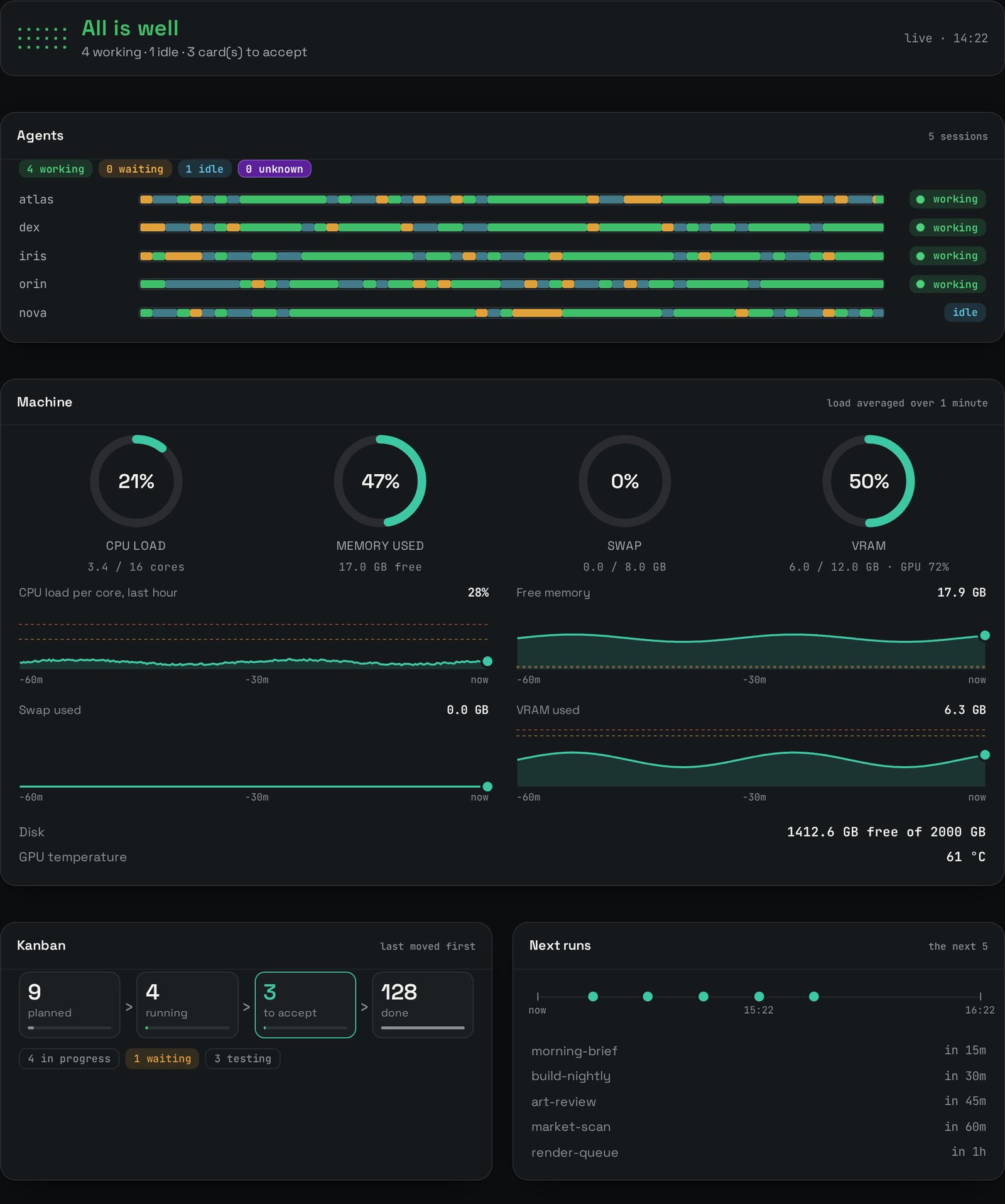
All of it on one screen.
Agents, board, schedules and machine health in one live panel: CPU, memory, swap and GPU at a glance. The status line on top changes colour the moment something needs a person.
YOUR AI TEAM
Coordinated. Reviewed. In control.
We build agent systems for businesses on the same foundations: clear roles, guaranteed handoffs, hash-locked approvals and hard spend caps.